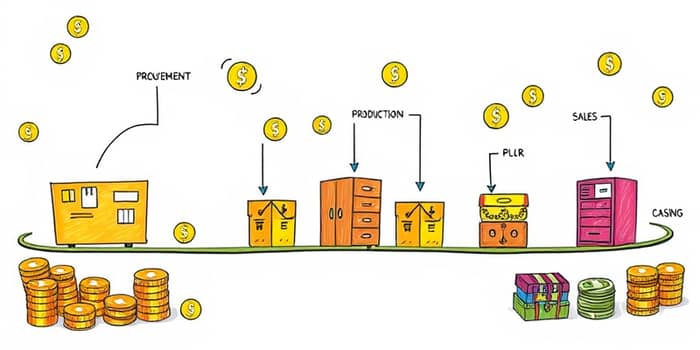
The Cash Conversion Cycle (CCC) is more than a financial metric; it is a lens through which companies can view and refine their entire operational process. By closely examining the time cash is tied up in inventory, receivables, and payables, organizations can identify bottlenecks and opportunities for growth.
In today’s fast-paced market, mastering the CCC can spell the difference between thriving and merely surviving. With careful analysis and targeted strategies, businesses can achieve maximizing cash flow efficiency and uncover new avenues for reinvestment.
Understanding the Cash Conversion Cycle
The CCC tracks the journey of cash through three primary stages: purchasing inventory, selling products or services, and collecting payment. The formula is simple:
CCC = Days Inventory Outstanding (DIO) + Days Sales Outstanding (DSO) – Days Payable Outstanding (DPO).
Each component reveals a unique aspect of operational health:
- DIO: Measures how long inventory sits before sale.
- DSO: Captures the average time to collect receivables.
- DPO: Reflects how long the company can defer payment to suppliers.
By monitoring these intervals, organizations can transform operations into cash more quickly, reduce financing costs, and increase liquidity. A concise CCC indicates that funds cycle rapidly back into the business, supporting expansion and resilience.
Interpreting Your CCC Results
Interpreting the CCC requires context. A shorter or even negative CCC often signals robust operational efficiency. For instance, technology companies and subscription-based services may collect payment upfront, resulting in a negative cycle where cash inflow precedes supplier payments.
Conversely, industries with long production lead times—such as manufacturing or construction—typically exhibit longer cycles. Rather than viewing a high CCC as inherently negative, it’s crucial to benchmark against peers and historical performance.
Regularly tracking CCC against target thresholds and industry norms is essential. A slight increase over time may indicate emerging inefficiencies, such as overstocked inventory or delayed customer payments.
Practical Strategies for Optimization
Improving the CCC involves three core levers: reducing DIO, shortening DSO, and extending DPO. Implementing a combination of these tactics can lead to dramatic shifts in cash availability.
- Reduce DIO
- Adopt Just-in-Time (JIT) inventory to lower carrying costs.
- Enhance demand forecasting with data analytics.
- Streamline supplier relationships and consolidate orders.
- Reduce DSO
- Offer early payment incentives, such as discounts for quick remittance.
- Automate invoicing and reminders using cloud-based software.
- Consider invoice factoring to accelerate cash collection.
- Extend DPO
- Negotiate longer payment terms with vendors.
- Optimize payment schedules to align with cash inflows.
- Leverage supplier financing programs when available.
Beyond these core actions, companies can introduce advanced measures such as dynamic discounting, which adjusts supplier payments based on current cash positions, and supply chain financing to bridge funding gaps.
Implementing Continuous Improvement
Achieving a lean CCC is not a one-time project but an ongoing discipline. Embedded within a culture of continuous improvement, CCC optimization can deliver sustained advantages.
Begin by establishing clear performance metrics and reporting cadence. Weekly or monthly dashboards should highlight DIO, DSO, and DPO trends, flagging deviations swiftly. Empower cross-functional teams—from procurement and production to sales and finance—to collaborate on problem-solving.
Regularly revisit policies and renegotiate terms. As relationships strengthen, suppliers may grant even more favorable conditions. Likewise, customer satisfaction initiatives can reduce payment delays by enhancing trust and loyalty.
Unlocking Future Growth
When companies master the CCC, they effectively strategic working capital management becomes ingrained in every decision. Freed from unnecessary financing costs, firms gain the power to invest in innovation, enter new markets, and navigate economic downturns with confidence.
Senior leadership plays a pivotal role. By championing cash efficiency goals, CFOs and CEOs send a clear signal that every department must align behind the objective of unlock financial agility. This unified focus can transform working capital from a static balance sheet line item into a dynamic source of competitive advantage.
Ultimately, the CCC is both a mirror and a map. It reflects current operational health and guides companies toward smoother, more resilient pathways. By cultivating a deep understanding of each cycle component and embracing proven optimization strategies, businesses of all sizes can convert working capital challenges into engines of growth.
References
- https://www.workingcapitalhub.com/fact-sheet/working-capital-and-the-cash-conversion-cycle-definition-calculation-and-considerations/
- https://trovata.io/blog/financial-efficiency-cash-conversion-cycle/
- https://365financialanalyst.com/knowledge-hub/corporate-finance/cash-conversion-cycle/
- https://www.jpmorgan.com/insights/treasury/receivables/understanding-and-optimizing-your-cash-conversion-cycle
- https://www.clearlyacquired.com/blog/working-capital-in-m-a-role-of-cash-conversion-cycle
- https://www.stocktitan.net/articles/cash-conversion-cycle-complete-guide
- https://taulia.com/glossary/what-is-the-cash-conversion-cycle-ccc/
- https://www.cfobrew.com/stories/c/cash-conversion-cycle-measures-efficiency-of-working-capital
- https://www.wallstreetprep.com/knowledge/cash-conversion-cycle-ccc/
- https://capstonetrade.com/the-cash-conversion-cycle-and-its-impact-on-working-capital-generation/
- https://www.celonis.com/blog/cash-conversion-cycle-what-it-is-and-the-metrics-that-matter
- https://www.mccrackenalliance.com/blog/cash-conversion-cycle-how-cfos-optimize-liquidity-and-working-capital