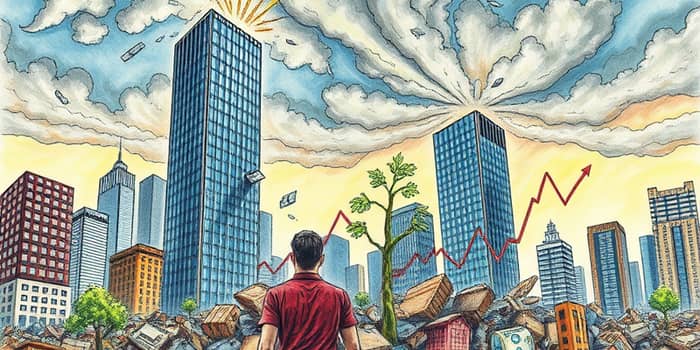
Corporate defaults leave lasting scars on economies, investors, and communities. By tracing the narratives of historic failures, we can uncover actionable strategies to mitigate risk and build stronger organizations.
Iconic Corporate Failures: Lessons from History
The collapse of Lehman Brothers in September 2008 stands as the largest corporate bankruptcy in US history. With $639 billion in assets and $120.2 billion in debt, Lehman’s exposure to subprime mortgages and hidden liabilities through repurchase agreements triggered a global financial panic. No government bailout to rescue the bank forced the sale of assets and the loss of 25,000 jobs.
Enron’s downfall in 2001 revealed the dangers of fraudulent accounting practices to hide debts. Despite $63.4 billion in assets, special-purpose entities masked liabilities, sending Enron’s stock from over $90 to under $1. The collapse wiped out employee retirement savings and led to Arthur Andersen’s demise for document destruction.
General Motors filed for Chapter 11 on June 1, 2009, after decades of market share decline, high labor costs, and plummeting auto sales. A $50 billion US government bailout enabled restructuring, but thousands of factory jobs vanished. Washington Mutual’s 2008 failure—$307 billion in assets and a $16.7 billion bank run over ten days—underscored aggressive subprime lending’s perils.
More recent defaults, such as Silicon Valley Bank in March 2023, Diamond Sports Group’s $8.7 billion default, and Loyalty Ventures’ collapse, remind us that vulnerability persists even after regulatory reforms. Iceland’s sovereign default in 2008, with $85 billion in banking debts, left 50,000 citizens bereft of savings and revealed systemic risks beyond purely corporate failures.
Quantitative Trends: The Rising Tide of Risk
Default rates have surged across sectors since 2015. Global corporate risk climbed by 40% over ten years, while US corporates saw a 55% increase. By end-2024, average default risk for US public companies hit 9.2%, echoing post-GFC highs. High-yield defaults peaked at 13.7% in 2009 and 16.4% in 2002, then fell to 1.3% in 2010.
Over a 150-year span, default cycles reflect broader economic shifts—from the Panic of 1873 through the Great Depression, 2008 crisis, and the COVID-19 shock. Understanding these patterns equips leaders to anticipate stress points and shore up resilience.
Sector Vulnerabilities: Identifying Fault Lines
Not all industries face equal default pressures. Some segments exhibit over-leverage and risky lending practices, while others remain relatively stable. Recognizing these nuances informs targeted risk management.
- Telecoms, Consumer Services, Health Care, Oil & Gas: risk up over 50%, highly volatile
- Banking & Finance (1980–2010): average default rate 8.3%, cyclically sensitive
- Automotive: average 7.4% default rate, exposed to demand shocks and labor costs
- Basic Materials, Utilities, Technology: moderate risk increases around 25%
- Gold Mining: rare net improvement tied to sustained high gold prices
Emerging vulnerabilities can be spotted early by tracking credit spreads, leverage ratios, and macroeconomic indicators such as inflation—US CPI rose 40% between 2015 and 2025—and sovereign debt burdens.
Causes and Impacts: Unraveling Root Triggers
Defaults often share common catalysts. Identifying these economic contagion and market panic triggers enables preemptive action.
- Housing and subprime mortgage bubbles: Lehman Brothers, Washington Mutual
- Fraudulent accounting and hidden debts: Enron and associated audits
- Over-leverage: reliance on short-term funding, repurchase agreements
- Global crises: 2008 financial panic, COVID-19 shutdowns, 2016 globalization stall, Ukraine conflict
- Sector-specific pressures: high labor costs in auto, volatile commodity prices in energy and materials
The human and economic fallout can be profound: tens of thousands of job losses, wiped retirement savings, market contagion across borders, and costly bailouts. Recognizing early warning signs and stress-testing balance sheets are essential to avoid repeating past missteps.
Forward Strategies: Applying Lessons to Future Risks
Building robust risk frameworks demands both quantitative vigilance and cultural integrity. By learning from past failures, corporate leaders and investors can implement strategies to strengthen resilience.
First, enforce rigorous transparency in financial reporting. Develop internal controls to prevent fraudulent accounting practices to hide debts and ensure clear disclosure of off-balance-sheet exposures. Regular third-party audits and real-time monitoring of leverage ratios can spot vulnerabilities before they escalate.
Second, diversify funding sources and extend debt maturities to reduce refinancing risk. Encourage conservative liquidity buffers and stress-test liquidity positions under various economic scenarios, including sudden rate spikes or demand collapses.
Third, adopt dynamic sector analysis. Track default probabilities by industry, adjust portfolio allocations away from segments showing rapid deterioration, and consider hedging strategies for cyclical exposures. Financial institutions should integrate machine-learning models that capture nonlinear risk patterns emerging from macro shocks.
Fourth, cultivate a risk-aware culture. Encourage whistleblowing, democratize risk reporting, and align executive incentives with long-term stability rather than short-term gains. Ethical leadership can prevent the sort of systemic concealment seen in Enron and other scandals.
Finally, collaborate with regulators and international bodies to refine early warning systems. Shared data on corporate health, loan delinquencies, and sector stress tests can help policymakers enact targeted measures before defaults cascade into full-blown crises.
By combining these practical approaches with an appreciation of historical patterns, organizations can decode the lessons of defaults and chart a path toward sustainable growth and resilience.
References
- https://www.fregolaw.com/5-famous-business-bankruptcies/
- https://www.creditbenchmark.com/data-insights/10-years-of-global-default-risk-trends/
- https://www.businessinsider.com/corporate-default-levels-highest-since-covid-moodys-major-players-2023-5
- https://www.ifc.org/en/insights-reports/2024/ifc-portfolio-default-rate-analysis
- https://www.ig.com/uk/news-and-trade-ideas/top-10-biggest-corporate-scandals-and-how-they-affected-share-pr-181101
- https://www.worldfinance.com/strategy/government-policy/top-5-worst-defaults-in-history
- https://www.moodys.com/web/en/us/insights/data-stories/us-corporate-default-risk-in-2025.html
- https://www.moodys.com/default_and_recovery_rates_02_09
- https://www.maalot.co.il/PDFViewer/Index/18660
- https://www.spglobal.com/ratings/en/regulatory/article/250523-default-transition-and-recovery-2024-annual-emerging-and-frontier-markets-corporate-default-and-rating-tra-s13491449
- https://www.fitchratings.com/research/corporate-finance/us-corporate-default-rates-ease-as-fed-cuts-loom-re-default-risks-persist-19-12-2025
- https://www.spglobal.com/ratings/en/regulatory/article/250514-default-transition-and-recovery-corporate-defaults-fall-below-long-term-average-s13489413
- https://fred.stlouisfed.org/series/DRALACBN