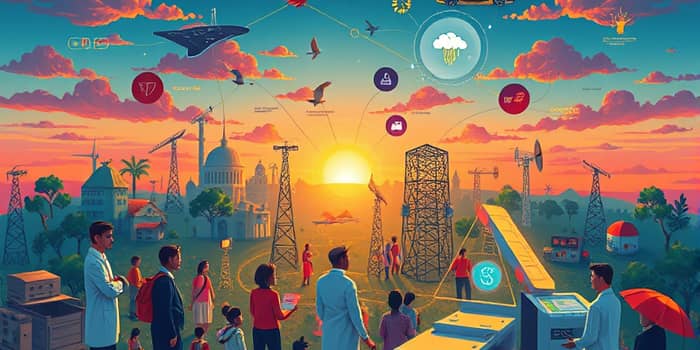
Imagine standing at the edge of a storm, sensing its distant rumble, and knowing exactly when to seek safety. That intuitive spark, amplified by data and communication, is the heart of modern early warning signals (EWS). These systems transform raw measurements into actionable intelligence, helping communities anticipate disruptions—from floods and disease outbreaks to market crashes and student dropouts.
At their core, EWS combine sensors, detection algorithms, and decision frameworks to minimize impacts through preparation. They guide us to act before a crisis unfolds, giving precious lead time when it matters most.
The Foundation of Early Warning Signals
Early warning signals rest on four pillars: risk analysis, monitoring, dissemination, and response. Each pillar demands rigorous data collection and continual engagement with stakeholders.
Risk analysis identifies potential threats and vulnerabilities, creating a baseline for what requires watchful eyes. Monitoring uses real‐time measurements and statistical indicators to detect deviations from normal behavior.
Dissemination ensures alerts reach every corner of society, leveraging sirens, SMS, or social media. Response capability then activates plans, mobilizes resources, and empower individuals and communities alike to act swiftly.
Key Statistical Indicators to Watch
Advanced EWS rely on subtle changes in system dynamics—known as emerging signals of critical slowing down—to forecast transitions toward instability.
- Increasing autocorrelation: States resemble their immediate past more closely.
- Rising variance: Fluctuations grow as shocks persist longer.
- Growing skewness: Distributions lean toward extreme states before tipping.
- Flickering between basins: Rapid jumps foreshadow shifts.
Detecting these signals involves time‐series analyses—autocorrelation functions, power spectra, and Fokker–Planck equations. Thresholds often trigger when metrics exceed two long‐run standard deviations. The longer the lead time, the greater the window for preventive measures.
Applications Across Domains
From natural hazards to financial markets, early warning signals safeguard lives, livelihoods, and well‐being.
- Natural disasters & climate: Droughts, heatwaves, wildfires predicted via satellite and ground sensors.
- Infectious diseases: Outbreaks or elimination detected by rising case variance and autocorrelation.
- Finance & business: Credit risks and client deterioration flagged through AI‐driven indicators.
- Traffic & public safety: Sirens, billboards, SMS alerts coordinate evacuations and manage flow.
- Education: Early warning indicators highlight at‐risk students for timely support.
In Europe, heatwave EWS recommended by WHO have saved countless lives by forecasting spikes in morbidity. In banking, AI‐enabled systems reduced projected credit losses by analyzing demographic trends and transaction patterns in real time.
Mapping the Four Core Functions
Building Resilience Through Early Warning
The true power of EWS lies not in technology alone, but in chains of information communication systems that connect data to decisions. Community drills, public education campaigns, and feedback loops ensure people know what to do when alarms sound.
Local leaders and schools play pivotal roles. In high‐risk districts, mock evacuations sharpen readiness. In hospitals, real‐time case dashboards guide resource allocation. Each practice strengthens the capacity to recover from shocks and fosters a culture of preparedness.
Putting Early Warning Into Action
Implementing an EWS begins with a simple question: What could go wrong, and how early can we know? From that starting point, assemble diverse partners—scientists, first responders, community advocates, and policymakers.
Next, deploy affordable sensors and harness open‐source software. Train volunteers to interpret data and relay warnings. Establish clear protocols: Who alerts whom? Via what channel? At what threshold? Regular drills turn theory into muscle memory.
Finally, embrace continuous improvement. Analyze false alarms and near‐misses. Refine thresholds and expand coverage. By learning from every event, systems become sharper and more reliable.
Toward a Safer Tomorrow
Early warning signals offer a promise: the chance to outwit disasters, curb epidemics, and avert economic downturns. They remind us that even the most complex threats leave footprints if we know where to look.
As we stand on an uncertain horizon—facing climate volatility, emerging pathogens, and rapid technological shifts—EWS illuminate the path forward. By weaving together data, technology, and human resolve, we can minimize dangers before they materialize and build a future where every community thrives in the face of change.
Whether you’re a scientist mapping climate thresholds, a teacher watching classroom attendance, or a banker assessing portfolio risks, your vigilance can spark the next generation of early warnings. Together, let’s spot trouble before it hits and safeguard our shared world.
References
- https://en.wikipedia.org/wiki/Early_warning_system
- https://worksafetci.com/2022/12/what-are-the-types-of-early-warning-systems/
- https://fiveable.me/key-terms/earth-systems-science/early-warning-signals
- https://pmc.ncbi.nlm.nih.gov/articles/PMC8479360/
- http://www.early-warning-signals.org/?page_id=480
- https://report-2023.global-tipping-points.org/section1/1-earth-system-tipping-points/1-6-early-warning-signals-of-earth-system-tipping-points/1-6-1-theory-and-methods-of-early-warning-signals/
- https://www.frontlineeducation.com/blog/grades-1-5-early-warning-indicators-and-elementary-vs-high-school-ewis/