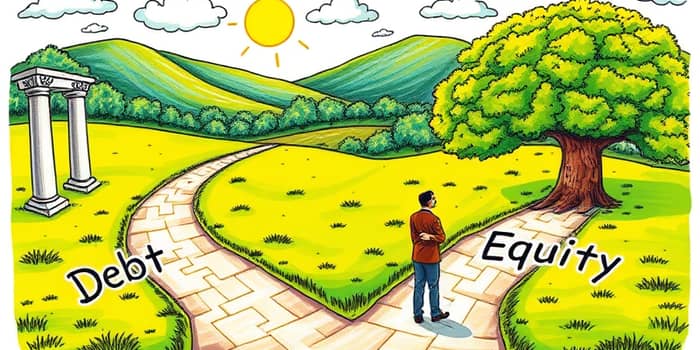
In today’s dynamic finance landscape, choosing between equity and debt financing can define a company’s growth trajectory.
This article offers actionable insights from a credit analyst’s perspective, helping founders, managers, and investors make informed decisions.
Understanding Core Concepts
At its heart, equity infusion involves selling shares or ownership stakes to investors in exchange for capital, no repayment obligation but with dilution of control.
By contrast, debt financing means borrowing funds that must be repaid with interest, preserving full ownership yet introducing fixed obligations.
Each approach carries distinct balance sheet, cost of capital, and risk implications that credit analysts evaluate rigorously.
Pros and Cons: A Comparative Table
Below is a side-by-side view of key attributes and their effect on credit risk and strategic flexibility.
Financial Examples and Real Numbers
Numbers bring concepts to life. Consider a SaaS startup that raises €2 million in equity for a 20% stake. If it exits at €50 million, the investor nets €10 million, while founders retain 80% ownership but share future gains.
Alternatively, a near-breakeven company might secure a €1 million credit line with an 8.5% interest rate, flexible credit lines that can be drawn when needed and repaid from revenue without giving up equity.
In practice, many high-growth firms adopt a hybrid: a €5 million Series A equity round first, then €1 million of venture debt post-revenue stabilization. This lowers weighted average cost of capital and balances dilution against leverage risk.
Types of Financing Instruments
Credit analysts evaluate each instrument’s repayment profile, collateral requirements, and covenants before recommending it.
- Debt Variants:
- Long-term bank loans with amortizing schedules
- Short-term emergency loans at higher rates
- Venture debt tailored to startups between VC rounds
- Revenue-based financing repaid as a percentage of sales
- Convertible notes that can convert to equity
- Equity Variants:
- Angel investments in early, high-risk stages
- Venture capital rounds for proven traction
- Strategic corporate investors offering industry expertise
Choosing the Right Structure for Your Stage
No single solution fits every situation. Credit analysts often recommend based on cash flow predictability, growth objectives, and tolerance for dilution.
- Debt Preferred: When revenue is stable, a DSCR above 1.5×, and you seek to leverage tax shields without surrendering control.
- Equity Preferred: In early-stage or volatile markets where cash to service debt is uncertain and rapid scaling is critical.
- Hybrid Approach: Equity as a safety net in the earliest rounds, followed by selective debt to fund expansion at a lower marginal cost.
Credit Analyst’s Perspective: Risk, Leverage, and Metrics
From a credit perspective, debt raises the debt-to-equity ratio, intensifying default risk if performance falters. However, it can boost return on equity in favorable conditions.
Key metrics include DSCR, interest coverage ratio, and debt maturity profiles. Analysts stress-test scenarios to evaluate whether projected cash flows can weather downturns.
Equity reduces leverage, spreading risk among shareholders. Investors share upside through dividends or exit gains, but they also often require governance rights, impacting strategic decisions.
Real-World and Hybrid Insights
Industry leaders often mix instruments to optimize cost and control. For example, a logistics startup may raise seed equity, prove unit economics, and then secure a revolving line of credit to fund fleet expansion without further dilution.
heycater! exemplifies this path: early VC capital for product-market fit, followed by tailored debt to accelerate profitability while protecting equity interests.
Ultimately, the optimal structure aligns with your stage, cash flow visibility, and long-term vision. Collaborate closely with credit analysts to model outcomes, stress-test assumptions, and choose the path that balances growth, risk, and control.
Conclusion
Deciding between equity infusion and debt financing is a pivotal strategic choice. By understanding core mechanisms, comparing pros and cons, and leveraging real-world examples, you can craft a capital structure that fuels sustainable growth.
Engage credit analysts early, harness data-driven models, and remain agile: the right mix of equity and debt can be the engine that propels your business to new heights.
References
- https://www.re-cap.com/blog/equity-funding-vs-debt-funding
- https://www.lucid.now/blog/capital-structure-scenarios-debt-vs-equity/
- https://www.pnc.com/insights/small-business/manage-business-finances/debt-financing-vs-equity-financing-a-comprehensive-guide.html
- https://www.truist.com/resources/commercial-corporate-institutional/financing/articles/debt-financing-vs-equity-financing
- https://www.bankrate.com/loans/small-business/debt-vs-equity-financing/
- https://www.hubspot.com/startups/fundraising/equity-vs-debt-financing
- https://redcliffetraining.com/blog/equity-financing-vs-debt-financing
- https://preferredcfo.com/insights/debt-vs.-equity-choosing-growth-without-losing-the-wheel