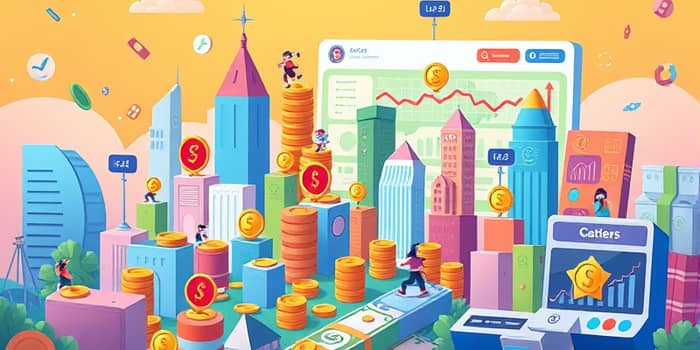
Saving money often feels like a chore, but by incorporating playful design and competition, financial goals become engaging challenges. This article explores how gamified saving transforms behavior, presents evidence of success, and offers practical tips to help you achieve your targets.
By understanding why people struggle to save and how game mechanics can counteract those tendencies, you can adopt strategies that turn routine deposits into rewarding experiences. Let’s dive in.
Why Gamification Transforms Saving Behavior
Traditional budgeting relies on delayed gratification, which clashes with our natural preference for instant rewards. Gamified saving, however, harnesses immediate positive reinforcement through points and badges to make every contribution feel satisfying.
Elements such as leaderboards, visual progress bars, and surprise prizes stimulate motivation, encouraging consistent action. Over time, these design features build habits that last beyond the novelty phase.
- Real-Time Rewards: Points or badges appear instantly after saving actions.
- Competition and Social Accountability: Leaderboards spark friendly rivalry.
- Visual Progress Tracking: Charts and maps reveal milestones.
- Unexpected Bonuses: Random cash prizes keep users curious.
Evidence of Effectiveness
Empirical studies consistently show that gamified saving tools drive measurable improvement. In one pilot, Walmart MoneyCard users receiving cash rewards for savings saved 35% more on average a year later. Similarly, SavingsQuest app users achieved a 25% increase in their savings frequency compared to non-users.
A field experiment involving a gamified web app with leaderboards saw participants more likely to meet their goals over a four-week period, regardless of financial literacy or self-control. These gains persisted even when controlling for personality traits like tightwad or spendthrift tendencies.
Competitive elements have proven effective in controlled studies. In two separate experiments involving 618 participants, adding a leaderboard feature significantly boosted saving intentions. A corporate 401(k) game at Staples yielded an 11% action rate after promotion, highlighting the appeal of interactive formats.
Leading Apps and Their Impact
Several platforms exemplify how gamified saving can work in practice. The following table summarizes key tools, their defining features, and results observed by users.
Psychological Foundations Behind Gamified Saving
Gamified saving taps into core principles of Self-Determination Theory, nurturing a sense of competence and autonomy through clear feedback loops. Small wins like earning a badge satisfy our need for mastery and make the process intrinsically rewarding.
Moreover, unpredictable rewards trigger dopamine responses similar to those in gaming or slot machines, helping override the temptation to spend impulsively. By converting abstract numbers into tangible achievements, users experience real-time reinforcement that fuels habit formation.
Practical Strategies to Boost Your Savings
You don’t need to switch apps to reap gamification’s benefits. By adopting simple tactics, you can transform mundane saving into an engaging pursuit.
- Set Micro-Goals: Aim for $5 or $10 increments and celebrate each success.
- Create Self-Challenges: Reward yourself after hitting deposit streaks.
- Involve Friends: Launch small competitions and share progress.
- Track with Visuals: Use colored charts or journals to map growth.
- Mix Reward Types: Combine predictable points with surprise treats.
Looking Ahead: The Future of Financial Gamification
As technologies like augmented reality and blockchain mature, gamified saving will evolve. Imagine location-based savings quests that link real-world behavior to virtual rewards, or tokenized incentives you can trade peer-to-peer.
Financial institutions are exploring deeper integrations, from retirement planning to debt reduction, making every aspect of personal finance more interactive. The success of tools like Pokémon GO underscores public appetite for blended digital and physical experiences.
Conclusion
By reframing saving as an interactive challenge rather than a chore, gamified designs harness basic human drives—competition, mastery, and curiosity—to build lasting financial habits. Whether through specialized apps or DIY strategies, you can leverage these techniques to transform your relationship with money.
Embrace gamification, set clear challenges, and celebrate every milestone. With playful intention, your savings goals will become not just achievable, but genuinely enjoyable.
References
- https://www.bankrate.com/banking/savings/gamification-helps-people-save-more-money-savings/
- https://pmc.ncbi.nlm.nih.gov/articles/PMC8046219/
- https://www.bostonfed.org/publications/communities-and-banking/2017/spring/the-gamification-effect-using-fun-to-build-financial-security.aspx
- https://onlinelibrary.wiley.com/doi/full/10.1002/cfp2.70016