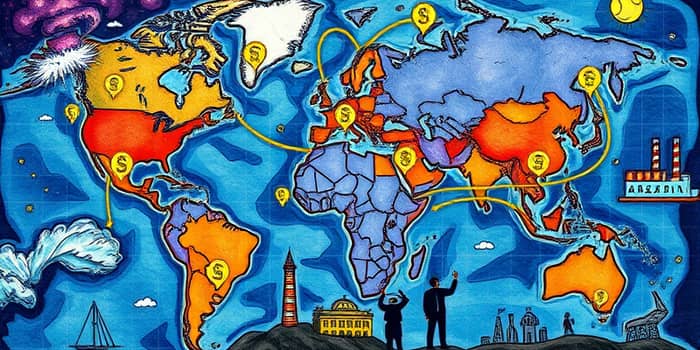
In an increasingly interconnected global economy, events in one corner of the world can trigger waves of disruption thousands of miles away.
From sudden political upheavals to devastating natural disasters, comprehensive geographic risk analysis is essential for organizations seeking to protect investments, supply chains, and communities against unforeseen shocks.
Understanding Geographic Risk
Geographic risk refers to all location-specific threats that can undermine economic stability, business operations, or investment returns.
Unlike country risk—which emphasizes financial and political stability metrics—geographic risk also encompasses environmental hazards and social dynamics tied directly to a region’s physical and cultural landscape.
- Political and Geopolitical Instability: Coups, civil unrest, trade tensions (e.g., US–China tariffs)
- Economic Volatility: Inflation spikes, budget deficits, dependence on single industries
- Environmental Hazards: Earthquakes, floods, monsoons, hurricanes, climate change effects
- Regulatory and Legal Shifts: Trade policy changes, capital controls, corruption
- Social and Cultural Factors: Demographic trends, piracy in shipping routes, weak rule of law
- Other Threats: Money laundering hubs, insurance concentration in hazard zones
Real-World Impacts
Consider the abrupt coup in a mineral-rich nation that halted global exports of rare-earth metals overnight, paralyzing production lines for smartphones and electric vehicles.
Seasonal monsoons in South Asia regularly wash out critical road and rail infrastructure, delaying millions of dollars’ worth of textile shipments and driving up logistics costs by double digits.
The COVID-19 pandemic, which originated in one region, swiftly cascaded into a worldwide economic downturn, exposing supply chain vulnerabilities that many firms had assumed were minor.
Analytical Methods for Regional Assessment
Quantifying the economic fallout of geographic risks requires specialized models that capture direct, indirect, and induced effects.
Tools like IMPLAN, REMI PI+, and the BEA Regional Impact Tool provide up-to-date data, local multipliers, and user-friendly interfaces for practitioners.
Quantifying Economic Effects
Multipliers are central to translating a shock into broader economic consequences. They measure how an initial disturbance generates subsequent spending rounds.
For instance, an Income-Expenditure model might calculate a long-term economic ripple effects multiplier of 1.0929, indicating that every dollar injected locally yields an additional $0.09 in secondary activity.
- Jobs Supported: Direct hires and supply-chain employment
- Payroll Impact: Wage flows across industries
- Output and Value Added: Changes to Gross Regional Product
- Secondary Indicators: Inflation, consumer spending shifts
Case Studies
In the fictional nation Mineral-Richland, sudden nationalization of mine operations cut off critical raw materials for electronics firms, triggering plant shutdowns abroad and $500 million in lost revenue within weeks.
Historically, the 2010 Eyjafjallajökull volcanic eruption in Iceland halted air traffic across Europe for days—costing airlines an estimated $1.7 billion and demonstrating how environmental risks can ripple through tourism, cargo, and commerce.
- Tech Innovations Inc.’s production freeze due to rare-earth embargo
- Port closures during Atlantic hurricanes delaying oil and grain exports
- Trade embargoes disrupting agricultural supply chains in developing nations
Mitigation Strategies
No region is completely risk-free, but organizations can reduce exposure through strategic diversification across multiple regions and by avoiding overreliance on any single source of supply or revenue.
Scenario planning exercises allow teams to stress-test operations against hypothetical events—ranging from port blockades to regulatory clampdowns—ensuring contingency plans are in place.
Maintaining a real-time dashboard of critical supply chain vulnerabilities assessment, supplemented by periodic site visits and local partnerships, empowers decision-makers to react swiftly as conditions evolve.
Looking Ahead
With climate change intensifying natural disasters and geopolitical tensions reshaping alliances, the stakes of geographic risk management have never been higher.
By integrating qualitative insights from IMF and OECD reports with quantitative rigour from advanced economic models, businesses and governments can transform risk into opportunity, building resilient systems that adapt and thrive.
Embracing a proactive, data-driven risk culture not only safeguards assets but also fosters innovation—ensuring sustainable growth in an unpredictable world.
References
- https://diversification.com/term/geographical-risk
- https://www.kyrosaml.com/geographic-risk/
- https://www.accaglobal.com/us/en/member/sectors/internal-audit/our-publications/geographic-risk-knowing-where-to-go.html
- https://www.bea.gov/news/blog/2024-07-17/bea-updates-regional-economic-impact-tool
- https://www.nasdaq.com/glossary/g/geographic-risk
- http://faculty.las.illinois.edu/irigoyen/georisk/
- https://alessa.com/blog/assessing-aml-geographic-risk/
- https://cedr.gatech.edu/economic-and-fiscal-impact-analysis-2/
- https://umbrex.com/resources/industry-analyses/how-to-analyze-a-property-casualty-insurance/geographic-risk-concentration-analysis/
- https://einhorn.cornell.edu/course/crp-3270/
- https://www.realized1031.com/blog/what-is-geographic-risk-in-real-estate