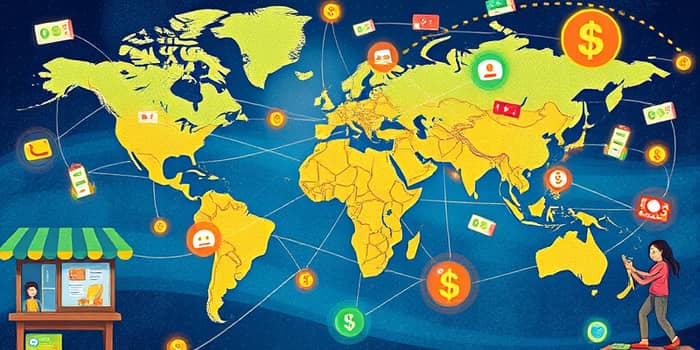
In an era where speed defines success, financial transactions can no longer afford delays. Real-time payments are revolutionizing the way money moves, offering unprecedented efficiency and transparency.
Definition and Core Characteristics of RTP
Real-time payments (RTP) represent instant, account-to-account money transfers that operate 24/7/365 without interruption. These transactions clear and settle in seconds, providing immediate fund availability and finality for both senders and receivers. Unlike traditional methods—such as ACH, cards, or wire transfers—that often suffer from cut-off times and multi-day clearing cycles, RTP bypasses these delays entirely. Funds transfer over secure networks and offer rich remittance data, enabling businesses to reconcile accounts with greater accuracy.
Each RTP transaction includes end-to-end communication and instant notifications, giving both parties confidence that payments have succeeded. Whether it’s a weekend purchase or a holiday payroll distribution, real-time payments ensure transactions process without regard to business hours or banking holidays.
How RTP Works
At its core, real-time payments rely on a specialized clearing and settlement infrastructure. When a payment is initiated, the sender’s bank forwards the transaction through a secure RTP network. Within seconds, the network validates the payment details, confirms available funds, and instructs the recipient’s bank to credit the beneficiary’s account.
Automated reconciliation is possible through integrated ISO 20022 messaging standards, which carry extensive remittance information. As of Q4 2024, 32.9% of cross-border messages adhere to ISO 20022, and global migration efforts aim for full adoption by November 2025. This transition accelerates real-time compliance and enhances data transparency, reducing manual intervention and reconciliation errors.
Market Growth and Statistics
The adoption of RTP has surged worldwide. In 2023, global real-time payment transactions reached 266.2 billion, representing a 42.2% year-over-year increase and accounting for nearly one-fifth of all electronic payments. Projections estimate transaction volume will hit $575.1 billion by 2028, while market size is forecast to expand from USD 35.71 billion in 2025 to USD 135.27 billion by 2031 at a compound annual growth rate (CAGR) of 24.85%.
Regionally, North America commands a 37.7% share of global RTP revenue, while the Asia-Pacific region leads in growth at a projected 28.1% CAGR through 2031. Over 70 countries now offer live instant payment schemes, with peer-to-peer transfers comprising more than half of transaction volume in many markets.
Business and Use Case Applications
Real-time payments unlock new possibilities across industries, driving efficiency and fostering innovation. Key applications include:
- Vendor and supplier payments: Immediate settlements on invoice approval improve supplier relationships and ensure uninterrupted supply chains.
- Merchant payouts and e-commerce: Sellers receive funds the same day, reducing cash flow gaps and increasing operational agility.
- Payroll and earned wage access: Gig economy workers and employees gain instant access to wages, enhancing financial well-being and retention.
- Refunds and bill payments: Instant refunds boost customer satisfaction and streamline dispute resolution for merchants and utilities.
- Wallet withdrawals and P2P transfers: Fintech platforms enable users to send and receive funds instantly, ideal for split bills or casual payments.
Regional Adoption and Trends
Financial institutions and regulators around the globe are embracing RTP. In North America, FedNow and The Clearing House RTP offerings have matured, with regional banks on-boarding rapidly. Canada’s Real-Time Rail goes live in 2026, and transaction caps are rising to $10 million, up from $1 million in early trials.
Asia-Pacific markets demonstrate massive scale. India’s Unified Payments Interface (UPI) processes billions of transactions daily, while Brazil’s PIX 2.0 is projected to handle $30 billion in e-commerce volume by 2025. Europe’s SEPA Instant scheme continues expanding interoperability across Eurozone nations, supported by ongoing cross-border pilot projects.
Latin America’s instant payment adoption also accelerates, driving financial inclusion through mobile wallets and QR-code payments in markets like Mexico and Brazil. Globally, cross-border RTP corridors are emerging, leveraging networks such as RippleNet and Visa Direct to offer end-to-end instant transfers.
- North America: FedNow, RTPF RFP surge, Canada Real-Time Rail
- Asia-Pacific: UPI scale, PIX expansion, Project Nexus pilots
- Europe: SEPA Instant growth, interoperability initiatives
Challenges and Future Outlook
Despite rapid growth, challenges remain. Interoperability between national schemes and cross-border settlement requires coordination among regulators, banks, and fintechs. Europe’s SEPA Instant adoption, while growing, still trails potential volume due to legacy infrastructure barriers.
Looking ahead to 2026 and beyond, RTP will transition from optional convenience to an expected standard. Anticipated trends include:
- Cross-border account-to-account corridors eliminating correspondent banking delays
- Invisible payment rails with tokenization and orchestration platforms
- Embedded real-time compliance checks and fraud prevention layers
- Integration of buy-now-pay-later (BNPL) models into RTP ecosystems
Opportunities abound for B2B payments, government disbursements, healthcare claims, and utility credits. As major players like JPMorgan, ACI Worldwide, and Walmart-Fiserv innovate, the RTP landscape will mature into a seamless, secure, and universal payment fabric.
Conclusion
Real-time payments mark a paradigm shift, transforming financial operations across the globe. By enabling real-time cash flow management and liquidity optimization across multiple accounts, businesses and individuals can transact with confidence and speed. Embracing RTP not only reduces costs and risks but fosters customer loyalty through transparency and immediacy.
As the global payment ecosystem evolves, real-time payments will redefine how value moves, empowering organizations of all sizes to thrive in a fast-paced digital economy. The end of waiting is here—welcome to a world of instant impact.
References
- https://developer.payments.jpmorgan.com/blog/guides/role-of-real-time-payments
- https://www.aciworldwide.com/real-time-payments-report
- https://aevi.com/newsroom/real-time-payments-and-the-future-of-faster-payments
- https://www.jpmorgan.com/insights/payments/real-time-payments/real-time-payments-driving-disruption
- https://www.nmi.com/blog/real-time-payments-is-the-us-finally-catching-up/
- https://www.mordorintelligence.com/industry-reports/real-time-payments-market
- https://tipalti.com/resources/learn/real-time-payments/
- https://www.360iresearch.com/library/intelligence/real-time-payments
- https://www.nuvei.com/posts/the-strategic-payment-framework-for-forward-thinking-businesses-in-2026
- https://www.thunes.com/insights/trends/payment-trends-shaping-the-next-phase-of-cross-border-growth/
- https://trustpair.com/blog/what-are-the-key-payment-trends-businesses-should-prepare-for-in-2026/
- https://thefinancialbrand.com/news/payments-trends/payments-outlook-2026-194517
- https://business.bofa.com/en-us/content/adoption-of-real-time-payments.html
- https://business.bofa.com/en-us/content/benefits-of-real-time-payments.html
- https://finzly.com/resources/blogs/new-10-million-real-time-payments-limit-changes-for-investment-banking/