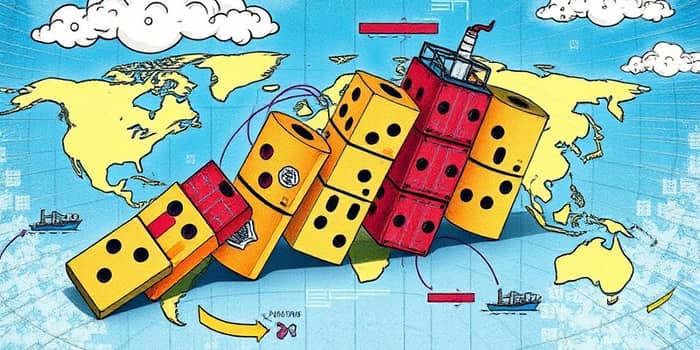
In an era of unprecedented volatility, supply chains face a series of interconnected shocks that ripple across industries and geographies. As disruptions become more frequent and severe, businesses must adopt a holistic perspective to anticipate and mitigate cascading failures.
The statistics are staggering: a 38% year-over-year increase in disruptions, a 27% probability of major disturbances, and average recovery times stretching two to three years. These figures underscore the urgency of rethinking traditional risk management approaches.
Understanding the Domino Effect
Supply chain disruptions rarely occur in isolation. A single event can trigger a chain reaction, amplifying costs and eroding revenue across multiple tiers. For example, a regulatory change in one country may necessitate sudden rerouting, which in turn drives up freight expenses and delays production schedules worldwide.
The concept of the domino effect reveals how an initial shock sets off cascading operational challenges and amplified financial consequences that touch every link in the network. Recognizing this dynamic is the first step toward resilient supply chain design.
Quantifying the Impact
To grasp the full magnitude of these disruptions, consider the following data:
- Average cost of a supply chain disruption: $1.5 million per day globally
- Operating expenses inflation: 3–5%
- Sales decline per disruption: approximately 7%
- Annual global revenue losses in 2024: around 8%
Beyond financials, the time to return to normal operations can span years, further compounding competitive disadvantages. Moreover, certain risks have surged dramatically:
Industry-Specific Vulnerabilities
Certain sectors suffer more acutely from intertwined disruptions. Life sciences, healthcare, and high technology have led the impact charts, with high-tech incidents rising 42% year-over-year. Automotive and general manufacturing follow closely due to complex tiered networks and just-in-time dependences.
These industries face intensified supply chain complexities that make recovery slower and risk management more challenging. Companies must therefore adapt tailored strategies rather than one-size-fits-all solutions.
Tariffs as Domino Triggers
Tariff adjustments are powerful catalysts that reverberate throughout sourcing, production, and distribution. When import duties spike, raw material costs escalate, squeezing margins and prompting firms to seek alternative suppliers.
- Changing sourcing patterns (65% of respondents)
- Renegotiating supplier contracts (57%)
- Nearshoring or reshoring operations (51%)
These responses exemplify the need for flexible transportation and sourcing strategies that can pivot in real time as trade policies evolve.
Technology as Defensive Armor
Emerging technologies offer a proactive defense against cascading failures. Artificial intelligence, predictive analytics, and digital twin modeling enable organizations to simulate disruption scenarios and optimize contingency plans.
By integrating AI-driven forecasting into routine operations, businesses gain end-to-end visibility that helps identify vulnerabilities before they escalate into full-blown crises.
Building Organizational Readiness
Structural change is essential. Supply chain resilience must become a core strategic priority, not an afterthought. Cross-functional collaboration elevates speed and agility in decision-making.
- Form an inter-departmental trade risk council
- Maintain auditable decision logs
- Operationalize real-time regulatory tracking
- Develop pre-negotiated contingency plans
Such measures foster a culture of preparedness, ensuring stakeholders from finance to operations can respond swiftly to emerging disruptions.
Charting the Path Forward
In 2026 and beyond, resilience will differentiate the winners from the rest. Companies must transform disruption management from reactive firefighting into a strategic growth driver.
Key strategic themes include quantifying network multiplier effects, focusing on sector-tailored action plans, leveraging AI for scenario modeling, and adopting dynamic inventory strategies. Firms that marshal these levers can contain disruptions and preserve customer trust, even when unexpected events strike.
By quantifying domino effects, embracing technology, and embedding flexibility into every contractual and operational decision, businesses can weather shocks and emerge stronger. The journey toward sustainable resilience demands unwavering commitment, but the payoff—a robust, future-ready supply chain—is well worth the effort.
Conclusion
Supply chain disruptions are no longer rare glitches; they represent constant, structural challenges that permeate every industry. Understanding and mitigating the domino effect is critical to safeguarding profitability and competitive advantage.
Through data-driven insights, technological innovation, and organizational cohesion, companies can turn vulnerability into resilience, ensuring smoother operations in an uncertain world.
References
- https://www.eliteasia.co/supply-chain-disruption-and-how-to-manage-it/
- https://www.chrobinson.com/en-us/resources/blog/build-resilient-agile-retail-supply-chains-for-2026/
- https://tax.thomsonreuters.com/blog/2026s-supply-chain-challenge-confronting-complexity-and-disruption-in-global-trade-tri/
- https://www.retaildive.com/spons/how-to-build-resilient-and-agile-retail-supply-chains-for-2026/806509/
- https://procurementtactics.com/supply-chain-statistics/
- https://www.supplychaindive.com/news/supply-chain-risks-trends-outlook-2026/810852/
- https://www.xeneta.com/blog/the-biggest-supply-chain-risks-of-2026-and-how-to-navigate-them
- https://www.supplychaindive.com/news/scarcity-redefines-the-2026-supply-chain-playbook/810052/
- https://www.weforum.org/publications/global-value-chains-outlook-2026-orchestrating-corporate-and-national-agility/
- https://www.ascm.org/making-an-impact/research/top-10-supply-chain-trends-in-2026/
- https://kpmg.com/xx/en/our-insights/operations/supply-chain-trends-2026.html