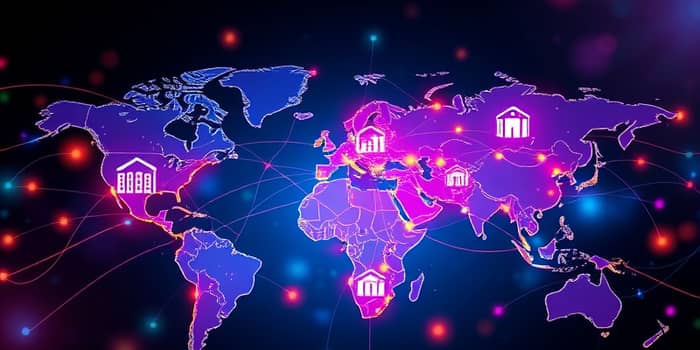
Over the past two decades, what began as simple data exchanges has transformed into an expansive network that fuels modern finance. Today, APIs act as the invisible threads stitching together banks, fintech firms, and non-financial platforms into a dynamic tapestry of innovation.
Historical Evolution: From Connectivity to Capability
In the early 2000s, APIs were little more than digital pipes, moving data between isolated systems. Yet as peer-to-peer payments gained traction and blockchain experiments captured imaginations, a new demand emerged: speed and agility.
Regulatory shifts and market pressures drove financial institutions to rethink their approach. Real-time payment rails, driven by a booming gig economy and the rise of e-commerce, exposed the limitations of legacy infrastructure. Banks and tech firms began to question: What if these connections could do more than transfer information?
- Rapid gig economy growth demanding instant liquidity
- Regulatory reforms enabling open finance frameworks
- Novel tech applications like AI and cloud
- Escalating need for agility in credit and FX
By the mid-2010s, APIs evolved into true enablers—no longer mere conduits but foundational components of corporate strategy. Platforms emerged that could not only connect systems but orchestrate end-to-end financial journeys.
APIs as Ecosystem Glue Today
Fast forward to 2026, and we find an era defined by intelligent composable platforms that power innovation. Financial institutions offer banking capabilities to non-banks, retail marketplaces embed loans at checkout, and machines autonomously settle transactions via IoT integrations.
These ecosystems deliver tangible benefits, reshaping how organizations acquire customers, manage risk, and generate revenue. Below is a snapshot of the five most significant advantages:
Global Examples: Pioneers of Interconnected Finance
Across continents, institutions showcase the power of collaboration. From J.P. Morgan’s integration with ERP systems to India’s Aadhaar-enabled on-boarding of over a billion users, these success stories illuminate what’s possible when APIs become strategic assets.
- J.P. Morgan: Building pre-integrated Treasury solutions with leading ERP and TMS platforms.
- SoFi: Achieving double-digit year-over-year growth by embedding lending and insurance.
- DBS (Singapore): A marketplace spanning property, health, travel, and education.
- Aadhaar (India): Biometric authentication linking mobile wallets to bank accounts for 1B+ users.
- Plaid (USA): A data network connecting over 7,000 fintech apps to 12,000 institutions.
Regulatory and Technological Enablers
Open finance initiatives and evolving standards have unlocked unprecedented interoperability. In Europe, the Data Act and Digital Markets Act demand portability, while FAPI 2.0 underpins secure API exchanges globally. On the technology front, cloud-native architectures blend seamlessly with Kubernetes and GitOps, delivering scale at lightning speed.
Moreover, AI-driven insights redefining decision-making and risk management are now non-negotiable. Predictive models embedded within API calls can detect fraud in milliseconds, personalize credit offers in real time, and anticipate liquidity shortfalls before they arise.
No-code and low-code platforms further democratize API consumption, empowering line-of-business teams to craft workflows without deep technical expertise. This convergence of standards, security, and simplicity propels the industry toward a truly open, composable future.
Challenges and the Road Ahead
Despite these advances, fragmentation remains a hurdle. Over 80 regulatory frameworks and tens of thousands of APIs operate in silos, creating complexity for global players. Data sovereignty and compliance across jurisdictions can slow adoption, while competition from BigTech threatens to consolidate power.
- Future partnerships with governments and nonprofits will drive inclusion.
- GenAI assistants embedded in workflows will boost developer productivity.
- Blockchain-based digital identities will simplify on-boarding.
- IoT-driven autonomous transactions will reshape supply chains.
- ESG-focused financial bundles will meet evolving consumer values.
Looking ahead, the next decade promises banks as orchestrators of non-financial ecosystems—from green home financing to healthcare marketplaces. By embracing cloud-native infrastructure and agile deployment models, institutions can knit together services that cater to every aspect of daily life.
As we stand on the brink of a fully integrated financial universe, the challenge is clear: move beyond data exchange to forge true collaboration. Those who dare to innovate, partner widely, and invest in composable architectures will not only survive but thrive.
Let this evolution inspire you. Whether you are a developer crafting the next API endpoint or an executive steering corporate strategy, remember that every connection you build brings us closer to a world where finance is not confined by walls but woven through the fabric of our lives.
References
- https://developer.payments.jpmorgan.com/blog/thought-leadership/transforming-apis-platform-enablers
- https://intellias.com/collaborate-to-win-the-power-of-financial-ecosystems-as-a-market-strategy/
- https://konghq.com/blog/engineering/api-a-rapidly-changing-landscape
- https://www.techforgood.net/guestposts/the-role-of-interconnected-systems-in-boosting-global-financial-inclusion
- https://www.idlen.io/blog/api-economy-developers-make-money-apis-2026
- https://tyk.io/blog/2026-the-year-apis-and-ai-become-non-negotiable-for-financial-services/
- https://plaid.com/resources/fintech/fintech-ecosystem/
- https://orbilontech.com/api-economy-2026-business-guide/
- https://www.finastra.com/viewpoints/articles/reimagining-banking-through-ecosystems-strategic-precision-future-ready-market
- https://dev.to/gdewilde/the-state-of-financial-apis-in-2026-80-frameworks-zero-convergence-and-why-ai-agents-arent-5a09
- https://www.ey.com/en_us/industries/financial-services/ecosystems-financial-services
- https://keyrus.com/us/en/insights/top-ai-trends-transforming-financial-services-for-2026
- https://www.mckinsey.com/in/~/media/ClientLink/Financial%20Ecosystems%20The%20Next%20Horizon%20for%20US%20Banks/McKinsey_Financial%20Ecosystems_The%20Next%20Horizon%20for%20US%20Banks_2017.ashx
- https://www.youtube.com/watch?v=Vu7RZRLiGUE