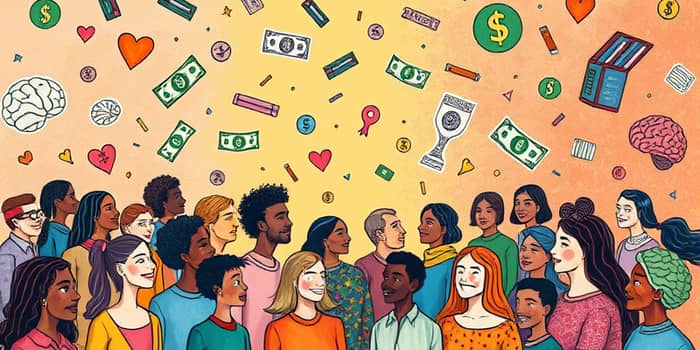
Every day, millions of decisions about spending and saving are shaped by forces that lurk beneath our conscious awareness. Behavioral economics reveals the hidden mechanisms—emotions, biases, social pressures—that pull us away from purely rational financial choices.
By understanding these invisible influences, we can reclaim control over our wallets and cultivate habits that support long-term well-being.
Why We Deviate from Rational Choices
Traditional economics assumes we calculate costs and benefits objectively. In reality, psychological shortcuts and emotional responses frequently override cold logic. Impulsive purchases fueled by dopamine can latch onto any fleeting mood, while the pain of paying fades with plastic, making debt easier to accrue.
Consider your next coffee run: despite a tight budget, that latte seems irresistible. It isn’t a lack of willpower so much as a predictable brain response—the thrill of anticipation activates reward centers, trumping your long-term goals.
Individual Differences and Money Personalities
Not everyone reacts the same way. Researchers have identified several money attitudes—ranging from obsession and power to anxiety and non-generosity. Some view every dollar as a tool; others see it as a mark of success or status.
On the Spendthrift-Tightwad scale, tightwads experience genuine psychological discomfort when spending, whereas spendthrifts lack that natural brake. Remarkably, these tendencies emerge by age five and predict real purchasing behavior, independent of parental influence.
Social and Environmental Influences
We are social creatures, and our peers and surroundings can nudge us toward unplanned expenses. Herd behavior can inflate asset bubbles, while social media heightens visibility bias—when we focus on others’ lifestyles, we try to match or exceed them.
A 2019 survey found that 35% of Americans admit to overspending to impress friends or followers. Digital payments further compound the problem by disconnecting us from the value of money, making it easier to swipe now and regret later.
Childhood Origins and Happiness Outcomes
By age five, children exhibit distinct spending styles. Spendthrifts will buy toys they barely like, chasing the thrill. Tightwads hesitate, sometimes missing out on real enjoyment. Parents can help by discussing the motivation behind each purchase, nurturing mindful habits early.
On the flip side, research shows that spending on experiences or gifts for others delivers more lasting satisfaction than material goods. Happiness from giving and learning outpaces the fleeting thrill of impulse buys, building a stronger emotional return on investment.
Practical Strategies for Better Habits
Knowing the biases is one thing; overcoming them is another. Here are concrete steps to align your actions with your goals:
- Automate savings and investments so you never see the money you won’t miss.
- Use commitment devices—apps that lock away funds or set spending limits.
- Wait a full 24 hours before non-essential purchases to let impulse fade.
For deeper self-awareness, map your personal money personality. Are you an avoider who shuts out finances? A status seeker who equates net worth with self-worth? Tailor your approach to your profile.
- Pay with cash where possible to heighten the pain of paying in real time.
- Seek free or low-cost activities—exercise, learning, volunteering—to satisfy your brain’s craving for novelty.
- Set clear, measurable goals: a vacation fund, emergency savings, or debt payoff milestones.
Viewing Behavior as a Finite Resource
Self-control can ebb and flow. Just like a budget, willpower is limited. Allocate your mental energy to decisions that matter most. Automate or delegate routine choices so you can focus your bandwidth on long-term planning.
Conclusion: Toward Mindful Money Mastery
Behavioral economics shines a light on the invisible currents guiding our financial choices. By illuminating biases like instant gratification, herd behavior, and the pain of paying, we can craft an environment that favors discipline over impulse.
Incorporate personalized strategies—automation, cash budgeting, delayed gratification—and nurture positive habits early. Over time, these incremental changes aggregate into lasting financial resilience and peace of mind. Empowered with insight, you can transform the way you spend, save, and ultimately live.
References
- https://blog.harvardfcu.org/behavioral-economics
- https://michiganross.umich.edu/rtia-articles/new-research-shows-children-form-attitudes-about-money-young-age
- https://www.structuralequity.org/blog/mind-over-money-behavioral-finance-and-the-psychology-of-spending-csb9g-4h6y5
- https://www.stmarysbank.com/learn/tools---resources/blog/detail/the-psychology-of-spending-and-how-to-manage-it
- https://betterworld.mit.edu/spectrum/issues/winter-1999/the-psychology-of-spending/
- https://www.surrey.ac.uk/news/cash-king-surprising-truth-about-spending-habits-cashless-world
- https://www.donnelly-boland.com/post/how-behavioral-economics-can-improve-your-financial-decision-making
- https://online.ucpress.edu/collabra/article/9/1/77305/196372/Understanding-Individual-Attitude-to-Money-A
- https://globalyouth.wharton.upenn.edu/articles/world-economy/5-truths-about-behavioral-economics-and-studying-consumer-behavior/
- https://pmc.ncbi.nlm.nih.gov/articles/PMC11659422/
- https://www.apa.org/monitor/2023/06/psychology-of-spending
- https://www.psychologytoday.com/us/blog/mental-wealth/202305/the-psychology-of-emotional-spending
- https://www.neuroscienceof.com/branding-blog/behavioral-economics-consumer-behavior-merle-van-den-aaker-interview
- https://www.thechicagoschool.edu/insight/psychology/behavioral-economics-individual-behavior/