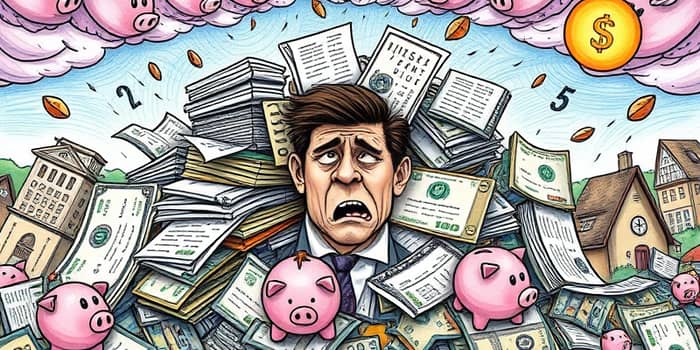
In the aftermath of pandemic relief, millions of borrowers, businesses and households face a mounting wave of delinquencies. Across sectors, loans once deemed safe now teeter on default, threatening individual futures and systemic stability.
The convergence of policy shifts, economic pressures and servicer breakdowns has created widespread post-pandemic repayment chaos, leaving many without a clear path forward.
Student Loan Default Crisis: A "Default Cliff"
Federal student loans have become the epicenter of America’s debt turmoil. With billions paused since 2020, borrowers are now confronting the harsh reality of reinstated payments and escalating balances. The predicted surge casts a long shadow over credit markets and household budgets.
- No billing statements or incorrect notices after payment pause ended
- Servicer transfers without warning, misapplied payments
- Income-Driven Repayment (IDR) enrollment paused, leaving 1.9 million in limbo
- Endless hold times and customer service failures nationwide
This sequence of failures has produced a historic scale of student defaults. In Q4 2025, 9.6 percent of borrowers were 90+ days delinquent, a dramatic leap from 0.7 percent in Q4 2024. Early delinquency transitions spiked to 16.19 percent, hinting at deeper distress.
The Federal Default Resolution Group is now grappling with over 1 million accounts more than 120 days past due. Borrowers face credit score drops and damage, mounting interest, and invasive collections.
Servicer misconduct has exacerbated the crisis. In 2024, Navient paid a $120 million fine for steering borrowers away from affordable plans—an example of broken loan servicing machinery that left many at risk of default.
Policy Shifts: The One Big Beautiful Bill Act (OBBBA)
Set to take effect July 1, 2026, the OBBBA overhauls repayment options and places new caps on federal borrowing. While aiming to streamline programs, it may leave gaps for many students.
- Graduate PLUS eliminated for new borrowers, forcing private alternatives
- Parent PLUS capped at $20 000 per year and $65 000 aggregate
- Unsubsidized loan lifetime caps of $100 000 (grad) / $200 000 (professional)
Existing IDR users must complete a Repayment Assistance Plan transition by July 1, 2028, creating urgency for outreach. Institutions have ramped up high-touch calls—up to 82 per account—to secure cures for FY 2024 delinquencies before new rules apply.
Yet without robust funding, 30 percent of student families will turn to private loans, transferring risk to higher-cost markets and deepening household strain.
Corporate and Leveraged Loan Defaults: A Brewing Storm
On the corporate front, leveraged loan defaults are expected to rise sharply in 2026. A recent survey found 77 percent of market participants foresee an uptick, compared to 50 percent a year ago.
- Restructuring agreements and covenant amendments
- Debt-for-equity swaps among distressed issuers
- Sales of nonperforming loans to private funds
Workouts are outpacing liquidations as lenders seek to salvage value, but rising interest rates and recession risks complicate recovery prospects.
Household and Commercial Debt Landscape
High student delinquencies compound broader borrowing challenges. Across the spectrum, consumers confront rising balances and tighter credit conditions, while banks report mixed trends in their portfolios.
As total household debt reaches $18.8 trillion, the cost of servicing multiple obligations forces consumers to prioritize auto or mortgage payments, leaving student loans vulnerable to neglect.
Paths to Recovery and Final Thoughts
Preventing a full default wave requires coordinated action. High-touch outreach, streamlined IDR enrollment and automatic payment adjustments can help borrowers stay current. Lessons from mortgage relief programs show that targeted assistance reduces re-default rates by nearly 50 percent.
Policy makers must refine federal programs and address funding gaps. Without intervention, private refinancing will lock families into higher rates, exacerbating inequality and undermining economic growth.
For borrowers, early engagement is critical. Contact servicers, explore repayment plans and leverage financial counseling. Collective efforts can avert the worst fallout of rising defaults amid economic pressures, restoring stability and hope to those burdened by debt.
References
- https://www.iontuition.com/2026-student-loan-default-crisis-funding-gaps-and-private-loans/
- https://www.fticonsulting.com/insights/reports/2026-leveraged-loan-market-survey
- https://debtcollectionlab.org/research/falling-off-student-loan-default-cliff/
- https://www.newyorkfed.org/newsevents/news/research/2026/20260210
- https://fred.stlouisfed.org/series/DRALACBN
- https://www.mba.org/news-and-research/newsroom/news/2026/02/12/mortgage-delinquencies-increase-in-the-fourth-quarter-of-2025