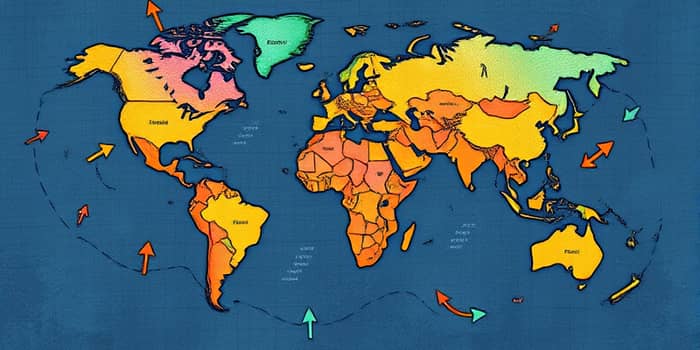
In an age defined by rapid shifts in power, trade tensions and military conflicts reach beyond headlines to shape the health of global credit markets. When war breaks out or strategic rivalries intensify, the ripples spread through banks, corporations and entire economies. Understanding these dynamics empowers risk managers, investors and policymakers to prepare, adapt and ultimately thrive amid uncertainty.
This article unpacks the transmission mechanisms of geopolitical shocks, presents compelling data, reflects on recent events and outlines actionable steps to build more resilient financial systems.
Understanding the Channels of Transmission
Geopolitical shocks puncture the assumption of stability that underpins lending. They operate through three interconnected pathways that amplify familiar credit, market and operational risks.
First, the economic channel reduces investment, employment and GDP growth. Trade disruptions or energy sanctions drive up input costs and erode corporate cash flows. Borrowers in exposed sectors may struggle to meet obligations as margins shrink.
Second, the financial channel constrains credit supply. Banks often cut cross-border lending while preserving affiliate flows. Domestic lending can contract, widening loan spreads by as much as 30 basis points for firms with high exposure.
Third, the safety and security channel manifests through cyberattacks, operational disruptions and fragmentation of payment networks. Infrastructure vulnerabilities strain day-to-day operations and raise the probability of defaults.
Empirical Insights: Data That Speak Volumes
Empirical research quantifies the toll of geopolitical uncertainty on credit quality. Across studies, a two standard deviation surge in the Caldara-Iacoviello GPR index correlates with a 0.2 percentage point drop in bank capital ratios. Non-linear effects imply that extreme shocks erode solvency much faster than moderate spikes.
Another study of US syndicated loans from 1991 to 2019 finds that actual geopolitical events widen spreads and tighten terms more than mere threats. The impact is most acute for global supply-chain firms and those reliant on external financing.
Historical data reveal that wars and terrorist attacks widen corporate bond spreads most in the petroleum sector. The combination of operating performance declines and higher external finance dependence explains this heterogeneity.
Real-World Events: Lessons from Recent Conflicts
The 2022 Russia-Ukraine invasion offers a stark case study. Sanctions shattered supply chains, drove up energy costs across Europe and strained corporate balance sheets. Banks with direct exposure to the region faced higher loan provisions and slowed domestic lending.
The intensifying US-China rivalry in semiconductors and AI illustrates trade bifurcation. Export controls and tariffs fragment supply chains, redirect investment and elevate funding costs for firms trapped between competing blocs.
Emerging markets are not immune. Heightened GPR exacerbates sovereign risk, pushing public debt toward 100% of GDP by 2030. Regions with close geopolitical proximity to hotspots face downgrades, higher borrowing costs and fiscal strains from refugee influxes.
Building Resilience: Practical Steps Forward
As geopolitical risks move from a peripheral concern to a boardroom priority, institutions must adopt a proactive stance. The following strategies can fortify credit quality and protect stakeholders.
- Enhance scenario planning: Integrate geopolitical shock scenarios into regular stress tests to capture non-linear risks.
- Bolster capital buffers: Aim for surplus reserves above regulatory minimums to absorb sudden losses.
- Diversify exposure: Limit concentrations in conflict-prone regions and seek alternative trade partners.
- Strengthen cyber defenses: Deploy advanced monitoring to mitigate operational disruptions and payment system fractures.
Policymakers and regulators also play a critical role in shaping a resilient landscape:
- Coordinate micro- and macroprudential tools: Align buffer releases, countercyclical capital and liquidity requirements to cushion geopolitically driven shocks.
- Foster international alignment: Negotiate common standards for sanctions, data sharing and crisis management protocols.
- Support transparency in ratings: Encourage agencies to disclose how GPR factors into sovereign and corporate assessments.
Boards and executives must champion a culture of readiness. Encourage cross-functional teams to monitor geopolitical developments, engage in regular tabletop exercises and update risk appetite frameworks accordingly.
At the firm level, strengthening supply-chain resilience and exploring friend-shoring strategies when feasible can limit vulnerability to sudden trade blockades. Maintaining flexible working capital solutions helps cushion cash flow shocks.
By weaving these practices into the fabric of decision-making, organizations can transform geopolitical uncertainty from a source of dread into an opportunity for strategic advantage.
Ultimately, vigilance, coordination and adaptability are our strongest allies against an ever-evolving geopolitical landscape. As global tensions continue to test the limits of credit markets, those who prepare today will stand firm tomorrow.
References
- https://www.investmentexecutive.com/news/research-and-markets/geopolitical-turmoil-drives-rising-credit-risk-moodys/
- https://www.bankofengland.co.uk/speech/2025/january/carolyn-wilkins-fireside-chat-at-fitch-ratings-geopolitics-and-financial-stability
- https://www.spglobal.com/ratings/en/regulatory/article/geopolitics-what-are-the-credit-implications-of-the-emerging-global-order-s101659810
- https://www.afd.fr/en/resources/sovereign-credit-ratings-developing-countries-regional-biases-and-subjectivity-factors
- https://www.fitchratings.com/research/sovereigns/geopolitical-tensions-raise-emerging-market-credit-risks-in-2026-29-01-2026
- https://www.reply.com/avantage-reply/en/geopolitical-risk-in-banking-from-blind-spot-to-boardroom-priority
- https://core.axa-im.com/investment-institute/market-views/three-factors-investors-watch-2026-ai-geopolitics-and-credit-stress
- https://www.fitchratings.com/research/structured-finance/tariff-market-geopolitical-risks-persist-for-global-credit-24-07-2025
- https://ideas.repec.org/a/eee/ecolet/v234y2024ics0165176523004652.html
- https://onlinelibrary.wiley.com/doi/10.1002/ijfe.70109?af=R