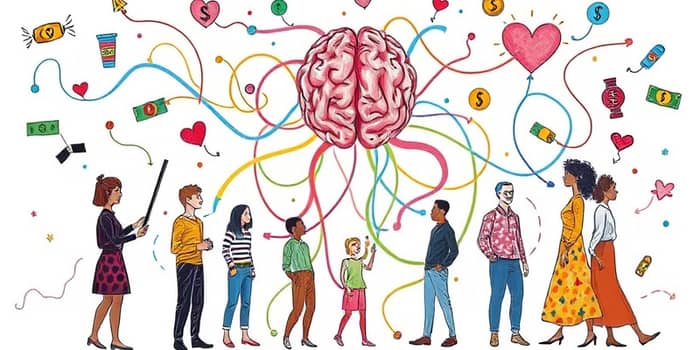
In today’s complex financial ecosystem, borrowing decisions extend far beyond interest rates and credit scores. Borrowers and lenders both navigate a web of emotional, cognitive, and social influences that shape how money flows and returns. By examining the invisible drivers behind borrowing and repayment, we gain insight into why individuals reach for loans, how they perceive ownership of debt, and what ultimately governs repayment behavior. This exploration uncovers powerful strategies to foster healthier lending relationships and more responsible borrowing practices.
Core Psychological Factors Influencing Borrowing Decisions
At the heart of borrowing behavior lie enduring personality dimensions that determine who feels comfortable taking on debt and for what purpose. Two primary needs consistently emerge as critical motivations.
- Need for Material Resources: Individuals with a strong desire for tangible possessions often show heightened intentions to borrow funds, particularly for purchases that confer visible status or utility.
- Need for Arousal and Stimulation: Those who crave excitement and novel experiences are more inclined to use diverse borrowing channels—ranging from home improvement and personal loans to payday advances—seeking the thrill of new opportunities.
Borrowers scoring low on these traits display a weaker link between attitude and actual borrowing intention. In contrast, high-arousal individuals consistently exhibit stronger motivations across multiple loan categories, demonstrating that underlying personality needs can amplify or dampen borrowing tendencies.
Six Psychological Determinants of Loan Repayment Behavior
Securing a loan represents only half the journey—consistent repayment depends on a distinct set of psychological factors. By understanding these determinants, lenders and financial counselors can better predict default risk and support timely payment.
- Effective Financial Decision-Making: The capacity to evaluate costs and benefits leads to more timely debt repayment.
- Self-Control and Conscientiousness: Individuals high in self-discipline and organization are significantly less likely to miss payments.
- Selflessness and Charitable Attitude: A generous mindset correlates with greater intent to honor loan commitments.
- Attitude Toward Money: Positive perceptions of money’s purpose influence both access to credit and repayment diligence.
- Neuroticism and Risk Aversion: High anxiety can deter loan requests, but may also lead to inconsistent financial behaviors if borrowing occurs.
Psychological Ownership of Borrowed Money
Beyond traditional predictors like income or credit history, the concept of psychological ownership of borrowed money reveals how much individuals feel that loan proceeds truly belong to them. This subjective sense transcends legal ownership and powerfully shapes borrowing behavior.
Consumers who internalize a strong sense of ownership over credit demonstrate higher willingness to take on new debt, independent of their self-control or pre-existing savings. Importantly, this perception is malleable through careful framing: language that emphasizes separation from personal funds can reduce borrowing propensity in targeted contexts, offering practical interventions for responsible lending initiatives.
Emotional and Neurological Dimensions
Neuroimaging research sheds light on the brain mechanisms that govern lending decisions. Activity in the nucleus accumbens—a region linked to reward and anticipation—doubles when lenders view borrower faces that elicit positive emotions. These neural signals predict loan approval outcomes, revealing that heightened reward processing underlies seemingly rational financial choices.
In a large-scale study of over 13,000 microloan requests, borrower photographs evoking high positive arousal achieved the greatest funding success. Conversely, images associated with negative emotions saw markedly lower approval rates. These findings underscore the profound influence of emotion and perception in peer-to-peer lending platforms.
Lender Psychology and Emotional Reactions
Lenders themselves experience varying emotional responses depending on how funds are used. Hedonic purchases—such as vacations or gadgets—trigger stronger negative feelings like anger, disappointment, or sadness when compared to utilitarian expenditures like educational courses or medical bills. Lenders often retain a lingering sense of deserved control over how their money is spent, and these unmet expectations can persist even after full repayment.
This residual dissatisfaction highlights the complex interplay of loss, sacrifice, and perceived fairness in personal loans. Understanding these emotional dynamics can guide lenders in setting clearer terms and borrowers in aligning requests with lender values.
Psychological Biases in Personal Lending
Personal lending relationships are also prone to self-serving biases. Lenders and borrowers alike may attribute financial outcomes to external factors when convenient, preserving positive self-images at the expense of objective assessment. These biases can distort communication and erode trust over time.
Loan interactions evoke a spectrum of emotions—from guilt and relief to anxiety and sleep disruption. Recognizing these affective consequences can help both parties approach lending discussions with empathy and honesty, ultimately fostering more sustainable financial partnerships.
Methodological Approaches and Study Design
Researchers employ diverse methods to unravel the psychology of lending, each offering unique insights and limitations.
- Regression analyses linking personality traits to borrowing intentions
- Logistic regression examining demographic predictors of repayment risk
- Neuroimaging studies tracking reward center activation during lending choices
- Large-scale internet experiments analyzing over 13,000 loan requests
- Survey research measuring attitudes, self-control, and financial planning propensity
- Experimental manipulations of debt framing to assess ownership effects
Key Research Gaps and Theoretical Implications
Despite significant advances, critical gaps remain. Many studies aggregate borrowing types, overlooking heterogeneity across loan categories. Disentangling motives for student, business, and payday loans could yield more precise interventions. Additionally, the distinction between attitude toward borrowing and actual intention merits clearer theoretical integration to avoid misleading conclusions.
Integrating insights from behavioral economics—recognizing the tension between fast, automatic decisions (system 1) and slow, deliberate reasoning (system 2)—can enhance predictive models of borrower behavior. By acknowledging behavioral economics theories, practitioners can design lending frameworks that anticipate cognitive biases and promote sound financial decisions.
In sum, the psychology of lending encompasses a rich tapestry of traits, emotions, neural processes, and social dynamics. Appreciating these hidden drivers empowers lenders to craft fairer policies and borrowers to engage debt more responsibly. By embracing a holistic, human-centered perspective, the financial community can build more equitable and sustainable lending ecosystems.