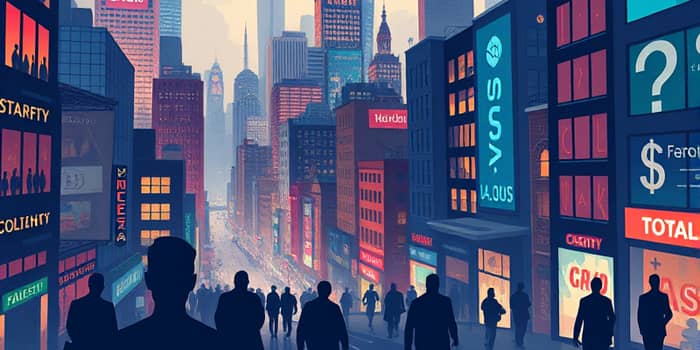
The shadow economy lives in the margins of formal markets, shaping societies and policies in profound ways. It thrives through unreported transactions, informal work, and clandestine exchanges that escape official oversight.
Understanding this hidden realm is essential for policymakers, businesses, and citizens who seek to build fair and resilient economies. By exploring its definition, scale, risks, drivers, and solutions, we can chart a path toward greater transparency and shared prosperity.
Definition and Scope of the Shadow Economy
The shadow economy encompasses economic activities outside formal markets, including unreported earnings, off-the-books employment, and underground trade. Such operations evade taxation and distort economic planning and forecasting, hindering accurate GDP measurement and effective policymaking.
Key components include concealed income, black market transactions, barter systems, and non-observed operations by both registered and unregistered entities. From street vendors trading in cash to sophisticated illicit networks, the spectrum of informality is broad and complex.
Global and Regional Size Estimates
In 2023, the shadow economy averaged 11.8% of global GDP, though arithmetic averages across countries reached 19.3%. While many nations have experienced declines since 2000—an average reduction of 6.7% of GDP—some regions still report exceptionally high informal activity.
Lower-income economies often see informal activity exceeding 30% of GDP, with more than 70% of employment in non-formal roles. Higher-income nations tend to report rates closer to 7–8%, reflecting stronger regulation and administrative capacity.
Key Risks and Negative Impacts
While the shadow economy may offer short-term survival avenues, it poses unreported risks across fiscal and social domains. Governments lose vital tax revenues, undermining public services and infrastructure investment.
- Tax revenue losses up to 5% of GDP create fiscal gaps.
- Distorted statistics impede effective policymaking.
- Undermines trust in public institutions and rule of law.
- Unfair competition harms compliant businesses.
- Facilitates money laundering and illicit financial flows.
By eroding institutional credibility and inhibiting growth, pervasive informality can trap societies in cycles of underdevelopment. Long-term studies suggest that sustained reliance on hidden markets depresses overall productivity and social welfare.
Drivers and Causes
The growth of the shadow economy is driven by a mix of economic incentives and structural constraints. High tax burdens and complex regulations often push individuals and firms toward informal arrangements.
- Excessive taxation and compliance costs compel tax evasion.
- Regulatory complexity boosts informal entrepreneurship.
- Weak governance and corruption lower the cost of operating underground.
- Cash-based cultures and inadequate enforcement mechanisms.
In developing countries, low government effectiveness and limited social safety nets leave many with no option but to work informally. In advanced economies, inequality and unemployment create parallel incentives for under-the-table work.
Policy Responses and Mitigation Strategies
Effective mitigation demands comprehensive data-driven policy frameworks that address root causes while protecting vulnerable groups. Abrupt crackdowns risk harming informal workers who rely on such incomes.
- Simplify tax codes and reduce tax complexity and burden to encourage compliance.
- Improve institutional capacity for detection and enforcement.
- Formalization incentives, such as access to credit and social benefits.
- Target non-financial enablers, including intermediaries in money laundering.
Gradual implementation, validated through field experiments, ensures that reforms deliver fiscal gains without deepening poverty. In many cases, partial reductions in informality yield significant revenue increases and heightened public trust.
International cooperation on anti–money laundering protocols and information sharing is also crucial. By tackling cross-border flows and shadow networks, authorities can reduce the global footprint of covert economic activity.
At the community level, outreach and education campaigns build awareness of the benefits of formalization and the risks of operating outside the law. Partnerships with civil society organizations can amplify these messages and support vulnerable populations.
Conclusion
The shadow economy is a multifaceted challenge, blending survival mechanisms with criminal enterprises. Its persistence reflects a complex interplay of policy design, governance quality, and economic pressures.
By embracing targeted reforms—simplifying regulations, strengthening institutions, and offering tangible incentives for formalization—governments can gradually shrink informality. Such efforts not only bolster public finances, but also restore trust in institutions and foster inclusive economic growth.
Addressing the hidden economy demands collaboration among policymakers, businesses, and citizens. Together, we can illuminate the shadows, safeguard public resources, and build economies where everyone plays and prospers by the same rules.
References
- https://www.iaw.edu/news-detail/shadow-economy-to-continue-slight-upward-trend-in-2026.html
- https://www.bcg.com/publications/2023/unveiling-the-shadow-economy
- https://amlwatcher.com/blog/shadow-economy-its-size-effects-and-aml-tactics/
- https://www.bls.gov/opub/mlr/2017/book-review/navigating-the-shadow-economy.htm
- https://www.ey.com/en_dk/insights/tax/why-the-shadow-economy-persists-and-how-governments-are-responding
- https://fiveable.me/key-terms/ap-macro/shadow-economy
- https://www.imf.org/external/pubs/ft/issues/issues30/
- https://blogs.worldbank.org/en/voices/five-reasons-be-concerned-about-shadow-economy
- https://www.marketplace.org/story/2024/05/31/how-large-is-the-shadow-economy
- https://www.worldeconomics.com/Informal-Economy/